A Stranger in the Inner Court
Ezekiel 44:7-9; Numbers 3:10, Acts 21:28,29
The temple as built by Solomon has four (4) major sections/courts (1 Kings 6 and 7, 2 Chronicles 2-7), the Court of the Gentiles also known as outer court specifically designed for strangers and non-Jews. This is where the animals for worship are sold, where Christ often taught and where the famous story of Jesus chasing the money changers was held (Matthew 21:12-13). The second court, the Court of the Women, the Court of the Israelites (where the Levites sing and where daily sacrifices were carried out.), and the Court of the Priest (also known as the inner court) which is exclusive to the priests and some Levites and is the section before the Holy of Holies, or the dwelling place of the tabernacle itself with the Ark of the Covenant, the Mercy Seat and the Tablets of stone. These sections or courts were each designed for specific reasons as seen in scriptures, in this discuss however, the section of interest is the Inner Court.
The 1812 work “The Heart of Man” by German theologian Johannes Gossner speaks about the continues battle for dominance in the human heart and the many forces that fight for this dominance. The book explains that whatever takes centre stage in the heart of man, defines the whole man. When the right forces (depicted as animals) move towards the centre, it affects his character, attitude and reactions positively but when the wrong forces take centre stage, they turn the man away from that which is good and in line with the will of God for him.

Following this, it is important to restrict entrance of negative forces into our heart. The Jewish Shema which is recited daily by practising Jews as seen in Deuteronomy 6:4-5 also speaks of “loving God” with all our hearts. It shows that the human heart can carry many characteristics, it can be deceptive and wicked (Jeremiah 17:9), but much more, has the propensity for goodness (Luke 8:15) hence the advice to guard it with diligence (Proverbs 4:23). The heart therefore is an important place of decision making, of dwelling and life. If the body is the temple of God (1 Corinthians 6:19), then the heart is its Inner Court.
- What is Inner Court
In biblical terms, the Inner Court as defined refers to an area in the temple complex close to the Holy of Holies, it is symbolic of purity, intimacy and worship (Ezekiel 8:16) and indicative of the separation of the sacred and the ordinary. This is where specific sacrifices and purification take place and has very restricted access as anything not meant to enter could lead to contamination, defilement and with-it grave consequences of plagues and/or death.
The Bible teaches that the temple at Jerusalem is a representation of heavenly things (Hebrews 8:5, Hebrews 9:23-24) and the tabernacle is a place of communion, a place where God meets man for communion, relationship and fellowship (Revelation 21:1-3). Jesus Christ the express expression and fulfilment of the Law (Matthew 5:17-20) however, has given us entrance into this innermost court by His death and resurrection (Hebrews 10:19-20). In His conversation with the woman by the well of Samaria, He said “…Woman, believe me, the hour cometh, when ye shall neither in this mountain, nor yet at Jerusalem, worship the Father… …But the hour cometh, and now is, when the true worshippers shall worship the Father in spirit and in truth: for the Father seeketh such to worship him. God is a Spirit: and they that worship him must worship him in spirit and in truth.” (John 4:21-24). This allegory by Jesus is definitive of the human heart which is where true worship resides. It is therefore safe to say within this context that the inner court is symbolic of the human heart where belief and faith originates and the decisions about life and death are made (Romans 10:10) which was why David cried for a new heart (Psalm 51:10, Ezekiel 36:26).
- Who is a stranger
A stranger is anything or anyone that does not belong. The Israelites were strangers in Egypt because they did not belong there, even in their laws, God made allowances for strangers (Exodus 22:21). When you look through scriptures however, God defined a stranger as anything that could potentially turn the children of Isreal or the heart of man away from Him or be a snare to them. The Egyptians were a polytheistic people serving multiple gods and this was a snare to Isreal (Exodus 23:33) which was why in Exodus 20:3, scriptures commands “Thou shalt have no other gods before me.”. This is also why in Jesus’ teachings, He admonished a cutting off of anything that will stop us from making heaven (Matthew 5:29-30). A stranger therefore can be:
- Sin – Sin is the ultimate stranger as it separates us from God (Isaiah 59:2) and God cannot behold iniquity (Habakkuk 1:13). Because God created man like Himself, man carries an essence of God. In Genesis 3, when man sinned, he realised that he was naked as the righteous covering that was God was stripped away when sin entered into him, causing eternal separation between God and man. You and your sin must separate, or you and your God will never come together. Message Outlines (Study 1 page 6).
- Idolatry – One of the things that caused more deaths and plagues in Isreal was idolatry which is the worship of other gods (Exodus 32, Numbers 21, Deuteronomy 29, Hosea 8, Judges 2 etc). Most prophets in Isreal spoke about idolatry. But Idolatry extends beyond the worship of other gods, it is a shifting away of the hearts of men from God (Matthew 15:8-9, Isaiah 29:13), it is covetousness (Colossians 3:5), it is a failure to trust, to obey and to serve (Exodus 32:9, Numbers 14:11), it is to reject God (1 Samuel 8:7) and all He stands for which is why it is abominable in Isreal. In Nehemiah’s time, he contended with them, plucked off their hair and made them swear as he understood that “A little leaven leaveneth the whole lump”. (Nehemiah 13:25, Galatians 5:9).
- An uncircumcised heart – In that ye have brought into my sanctuary strangers, uncircumcised in heart, and uncircumcised in flesh, to be in my sanctuary, to pollute it, even my house, when ye offer my bread, the fat and the blood, and they have broken my covenant because of all your abominations. And ye have not kept the charge of mine holy things: but ye have set keepers of my charge in my sanctuary for yourselves. Thus saith the Lord God; No stranger, uncircumcised in heart, nor uncircumcised in flesh, shall enter into my sanctuary, of any stranger that is among the children of Israel. (Ezekiel 44:7-9) which was why the Lord told the Israelites to circumcise the foreskins of their hearts in Deuteronomy 10:16. This scripture enumerates here that belief is more important than “hopeless demonstrative handwork”, that even when we offer our sacrifices, the kind of offering and the heart with which we offer is very important (Genesis 4:4-7, 1 Samuel 16:7).
- An unclean thing – The devil does not just walk into our lives; he comes ever so subtly using half truths and desires to shift our stands in Christ. He arms himself with various weapons like pride, lies, hatred, jealousy, malice, anger and uses these to creep into the heart of man. Paul’s advice to the Galatians “Walk in the Spirit, and ye shall not fulfil the lust of the flesh” (Galatians 5:16) is apt because “For all that is in the world, the lust of the flesh, and the lust of the eyes, and the pride of life, is not of the Father, but is of the world.” (1 John 2:16-17)
Whatever takes our time so much so that it affects our devotion is a stranger. In recorded scripture many different things fill this void. However, legitimate things like work, family, money and everyday life can also become strangers when they take centre stage in our hearts, shift us away from purpose or make us walk contrary to the will of God. The admonition of scripture is to put it all to death (Luke 9:23) as they have the potential of defiling or taking us away from God.
- How do you let the stranger in?
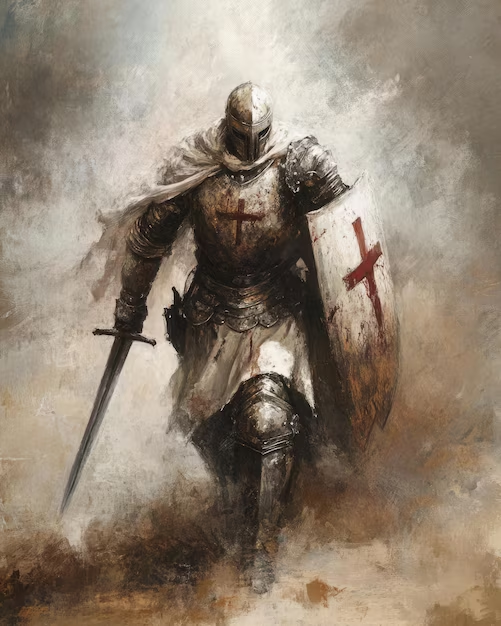
When Nehemiah went to rebuild the walls of Jerusalem, scripture records that they armed themselves with weapons and guarded against their enemies, day and night (Nehemiah 4:11-23). The life of a child of God is akin to this, because we live in a fallen world and bad things happen, we must always be at alert for our enemy like a wounded lion prows about seeking whom he may devour (1 Peter 5:8). Scriptures remind us not to be ignorant of the devices of the enemy (2 Corinthians 2:11) because if we know how he operates, we can fight with the word of God and the knowledge of the truth (Revelation 12:11, John 8:32). There are many ways we consciously or unconsciously let the enemy in, some of them are:
- Accommodating Sin: Sin is the ultimate stranger and by accommodating sin, we are invariably allowing the enemy to occupy our lives. Psalm 1 admonishes “Blessed is the man that walketh not in the counsel of the ungodly, nor standeth in the way of sinners, nor sitteth in the seat of the scornful. But his delight is in the law of the Lord; and in his law doth he meditate day and night.”. Jude warns that we should hate even the garment spotted with sin (Jude 1:23) while 1 Thessalonians 5:22 advises us to flee or “abstain from all appearance of evil“. Sin is the easiest way to let the stranger or enemy into our Inner Courts. As children of God, we must therefore strive for holiness and righteousness consistently rely on the grace and mercies of God to avoid/overcome sin for sin has no dominion over us (Romans 6:14).
- Ignorance of the word of God: One of the many tricks of the enemy is to keep Christians in the dark. Ignorance of the word of God deprives us from the knowledge of the truth and the promises of the father (Ephesians 4:18). When this happens, the stranger comes in through the lies of the enemy. When Jesus overcame the temptations of the devil in Matthew 4, He did so by the word of God. As followers of Jesus Christ, we too must arm ourselves with the sword of the Spirit which is the word of God (Ephesians 6:17-18, 1 John 1:7). The word of God is Spirit and life (John 6:63) and enlightens (Ephesians 1:8), it is quick and powerful (Hebrews 4:12), but much more, it saves (Romans 10:9-13, Ephesians 2:8-9).
- Weakness in study and prayers: We are at war, that is a fact. The way we fight is with the word of God and with prayers. SS&S 332 says “Prayer grasp eternity” so when we do not pray or equip ourselves with the word of God, we leave ourselves open to the attack of the enemy, to the stranger. It is like sleeping on the battle grounds, we become casualties of war. In Luke 11:21-22, we are told that only a stronger man can overcome and spoil our goods. Weakness makes the enemy to come in and detect many things to a Christian, weakness in prayers and the study of the word is how we let the stranger in.
- Leaving the door open: Sometimes, by our actions or inactions, we leave the door open for the stranger to walk in. Scripture says, “while men slept, his enemy came and sowed tares” (Matthew 13:25), this signifies a door left open as we are advised to watch and pray always. The story is also told of Jesus in Matthew 12:43-45 about when a spirit that leaves a man, and finding no rest, he comes back to that man and finds his house furnished and clean; so we have to be watchful because we know that from “…the days of John the Baptist until now the kingdom of heaven suffereth violence, and the violent take it by force.” (Matthew 11:12) so we have to “…be ye therefore wise as serpents, and harmless as doves.” (Matthew 10:16) as we are in the midst of wolves.
The inner court is God’s exclusive abode in the life of a believer. It is place of worship, of reverence and purity. However, it is also a place where battles are fought, and the enemy is always on a lookout to usurp the man of God. Because the inner court is where decisions are made. Whenever the strangers come into our inner court, it changes the tides of our conviction and leads man to damnation.
The famous work by John Bunyan popularly known as “The Pilgrim’s Progress” is a testament of the different roads travelled by the man seeking Christ. In it we find the trials that the Christian is often exposed to and how strength is sometimes found within the trenches of temptation and sin. One fundamental truth across the journey however was the state of the man’s heart, the many battles that are fought there and the importance of keeping the stranger out. If we guard the inner courts of our hearts and resist unto blood (Hebrews 12:4), we will find redemption in our obedience and the Lord, the righteous judge will bid us welcome on that faithful day far beyond the sea when the pearly gates are opened. May the Lord help us to be consistent in our belief and steadfast in our walk with Him in Jesus Christ name, amen.